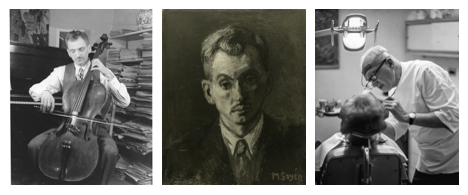
Portrait by Moses Soyer
Biography by Jacqueline Siegel (Max's Daughter)
Max was a true Renaissance man. The oldest of six children, Max grew up in lower Manhattan at the begining of the 20th century, before cars were invented and before airplanes flew. He lived to see men walking on the moon. In his high school years, he attended Townsend Harris Hall, a public New York preparatory high school linked to the City College of New York. Townsend Harris was one of the earlier selective schools in the country and offered a challenging course of studies for boys. Max was always proud that he attended that school. After high school, he went to college at City College of New York, working days and attending school in the evening, so he could afford his education. After college, he was accepted by NYU medical school. However, his mother insisted he go to dental school instead to make more money, as dentists were more prosperous than doctors in the 1920s. He always regretted not going to medical school.
As a dentist, he was known to be one of the best in New York. In the 1940s through the 1960s, his office was on West 42nd street near 6th Avenue in New York City, a location just across town from the United Nations. His friend and dental patient Ralph Bunch was the assistant secretary general of the UN and recommended Max to many of his friends and colleagues. As a result, Max had many international patients, some of whom became close friends.
Max was an avid reader and had a deep love of Irish literature, particularly James Joyce. When Joyce’s novel Ulysses was banned in the US, a group of Joyce lovers were able to smuggle the novel to the US a few pages at a time and then distributed the material to avid Joyce readers, including Max. Due to his interest in Irish literature and Ireland in general, he became good friends with the Irish Ambassador to the UN. In 1979, Max and his daughter flew to Ireland, celebrated Bloom’s Day in Dublin, rented a car, and drove all over the country, spending several days in Galway with the Ambassador and his family including a good Irish pub crawl and a day at Galway Races. Max continued to travel on his own in his 70s, visiting many European countries and enjoying new sights and new foods.
Max was also immersed in music and art. He spent a great deal of time making music tapes from his large record collection, and he played those tapes in his office all day. The music included classical, folk, and jazz. He particularly loved Yugoslavian folk music and dance, and he went folk dancing weekly with his then wife.
For a large portion of his life he played cello, practicing every evening after returning from work. As a younger man, he played with a small chamber music group that would occasionally receive new music from contemporary composers, much of which they found challenging. At home, classical music was always playing on the radio, and sometimes he would have musician friends come play chamber music in his home.
Max also had several good friends who were well-recognized contemporary painters. When artists were struggling financially, Max would accept paintings in lieu of money for his dental work. One of these paintings is a portrait of Max by Moses Sawyer included among the pictures here. Moses often visited Max and drew pictures to entertain his daughter, which she still has in her home.
Max died in 1979 of a heart attack. A short notice was placed in the New York Times, and the funeral held the next day. Despite the short notice, the funeral celebrating his life was standing room only.